

The Top Five Lessons I Learned from Don Draper
… and how they helped me get through one of the darkest times of my life.

On December 29, 2015, I was unexpectedly fired from a job I loved. It is very difficult to put into words the devastation that followed.
Last year, I wrote a post about how even the smallest aspects of my life were affected, like not being able to have breakfast while reading the newspaper, a daily routine I had kept for more than thirty years. You can read that post here
The breakfast-paper ceremony was the anchor that structured my day; without it, I lost all sense of time.
I guess, intuitively, I found a replacement. I started to watch Mad Men with my coffee and toasts.
I admit I arrived late to the party; by December 2015, Mad Men had already finished. The last episode was aired on May 17 of that year. I had watched one or two episodes before, and I knew there was a character named Don Draper. I remember having read an article about why women love Don Draper, and I totally get it, he is irresistible.
But after watching a couple of episodes and my fascination with Don grew, I realized I was not one of those women in love with Don, I was a woman who wanted to be like Don.
I knew he was a bad husband, a bad father, a bad brother, and the list could continue ad infinitum; he was basically a bad person. But he was in control. Nobody played with Don. And at that time, I felt the whole system was playing with me. I had lost all control of my life, and I wanted to regain it. And with Don´s help, I did.
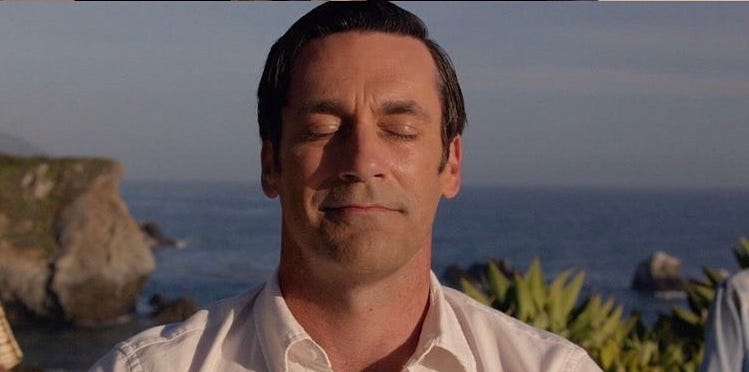
Ironically, my awakening came from watching Don in his cruellest version in episode “5G” (Season 1), when he refused to reconnect with his baby brother and told him: “I have a life, and it only goes in one direction. Forward.” After listening to that sentence, I knew I had to put myself together and design a plan to get out of the misery others put me through, and I did it following these five lessons Don Draper taught me:
Be in control of your life, in order to do that you need to act without guarantees. That message is very clear in two episodes: “Shut the door. Have a Seat” (Season 3) and “Blowing Smoke” (Season 4), in both episodes, Don finds himself trapped in difficult situations, with other people deciding about his future. In both cases, he takes action and makes things happen.
In my case, that meant getting myself out of the frozen state I was in, stopping waiting for someone to fix the big mistake of my dismissal, and starting to make movements and take decisions.
Sometimes it is necessary to have an unexpected reaction, in any negotiation, it is very important to keep the element of surprise. People usually expect you to act in certain ways based on your personality and previous behaviour. In “Field Trip” (Season 7), we see Don temporarily suspended from his position at the firm after having an emotional breakdown in front of an important client. Don knows he wants his job back and goes for it. The other partners are not happy with the idea of having him back, but he is a partner too, and the firm cannot afford to buy his shares; they also recognize his talent, and they don’t want him to work for a competitor. So, in order to persuade him to continue in this state of temporary suspension from his tasks, they decide to give him the opportunity to come back, but under unacceptable conditions and with a clause stating that any breach of these conditions would result in the firm reabsorbing his shares. They clearly expect Don to say no to this humiliating proposition, but he says yes, leaving the other partners astonished.
In my case, I knew that to minimize the damage caused to my career by the dismissal, it was important to get my job back. I needed to show continuity, in order to resign when the right opportunity appeared. In any career history, the difference between a dismissal and a resignation is enormous. Like Don, I was offered my job back under quasi-humiliating conditions, and like Don, I did the unexpected, I accepted. A year and a half later, I presented my resignation, on my terms.
Be graceful, even in the worst moments, you need to act gracefully. It is important to accept that sometimes you win, and sometimes you lose. It is in the latter situation that your true character shows. In “Shut the door. Have a Seat” (Season 3) Don is faced with the abandonment of his most important client and the betrayal of his long-suffering wife. First, he reacts badly, but in the end he acts with grandeur.
I know that during the year and a half that I continued working at my job, but in precarious condition, I still gave my best. Proof of that is the respect that my former colleagues still show me. Pettiness is never a good idea.
“If you don't like what´s being said, change the conversation.", this is one of the most famous Don's lines and is probably one of my favourites too. He says it in “Love Among the Ruins” (Season 3), when he talks with a client.
Don is talking about an advertising strategy, but this approach can work in any situation. To reframe the way we think about an unsolved problem is the best way to find a solution.
And what about the conversations we have with ourselves? By changing the stories we tell ourselves and the words we use to tell those stories, we can transform the narrative of our lives.
I truly believe that by choosing our thoughts we can rule our minds. I even wrote a poem about it, you can read it here.
Know your value, my favourite scene of Man Men is in one of the last episodes, “Lost Horizon” (Season 7). In this episode, McCann Agency has bought Don´s advertising firm. McCann had been after Don since the beginning of the series, but he never wanted to be part of that big corporation. In the scene I am referring to, Don attends a working lunch at the company. When he enters the room, he sees that the place is full of men who look like him. He is given his lunch inside a carton box. Each man in the room has the same box. Each man in the room laughs at the same time. Don realizes that he is one among others; he looks through the window and, without a word, gets up and leaves the room. With that gesture, he differentiates from the others and regains his autonomy.
When I was 11 years old, my school organized an art competition based on a short story about a rocket. We were divided into groups and had to make a rocket, using any material we wanted. All the rockets were going to be shown the following day at a school exhibition. My group gathered at the house of one girl, who, immediately after our arrival, told us how we were going to make our little piece of art. I told the group that I have an idea too, and I wanted to share it. She interrupted me and said: This is my house, and here we do what I say. Without a word, like Don, I got up and left.
With the help of my mother, I made my rocket. The following day, during the exhibition, I stood on my own in front of my artwork, and I explained my idea to each person that stopped to see my rocket. I knew my idea was good. I won the competition.
If you watched Mad Men, you know that after leaving that room, Don created one of the best commercials in advertising history. I think he also won the competition.
Sometimes, the outcome is not so clear.
Two years ago, I left another room. I was negotiating my new working contract. I was not happy with what was offered and stated that I wanted better condition based on my experience and knowledge. At that moment, someone shouted at me: Nobody cares who you are! I left without a word, but thinking: I care about who I am and I know my value.
So far, leaving that room has taken me to Paris and to Substack. Not too bad!
I still watch Mad Men during breakfast twice or three times a week, and I always cry at the last scene.
I am not spoiling anything by telling you that after 92 episodes, the last line of the series said: “New day, new ideas, new you.”
Simple, but significant.
I'll be waiting for more posts like this here!!